How to Stop Voucher Code Sites Stealing Affiliate Sales
27/10/2026 Written by Mark Kelly
Voucher websites can make an affiliate programme look more successful than it really is. They often generate high conversion rates and impressive tracked-revenue figures, but not every sale they receive credit for is a sale they created.
Consider a shopper who finds your brand through Google, reads a product review published by a content affiliate and adds an item to their basket. Before completing the purchase, they search for a discount code, click a voucher website, and return to your checkout. Under last-click attribution, the voucher publisher may receive the commission, even though another channel or publisher helped generate the original demand.
This is voucher affiliate cannibalisation. Your business pays commission for a sale that may have happened anyway.
The answer isn't to remove every voucher publisher. Some genuinely introduce new customers, encourage shoppers to complete purchases and help retailers compete on price. The challenge is distinguishing publishers that generate additional revenue from those that simply intercept existing demand.
In this guide, I'll explain how to identify Voucher Code Sites taking credit for affiliate sales, investigate last-click attribution issues, and introduce publisher rules that protect your affiliate programme's profitability.
How to identify Voucher Code Sites cannibalising your affiliate sales
Before changing commission rates or removing publishers, you need to understand what is happening within your affiliate programme. A high volume of voucher-attributed sales does not automatically mean a publisher is adding value.
I recommend looking at several signals together rather than making decisions based on one metric.
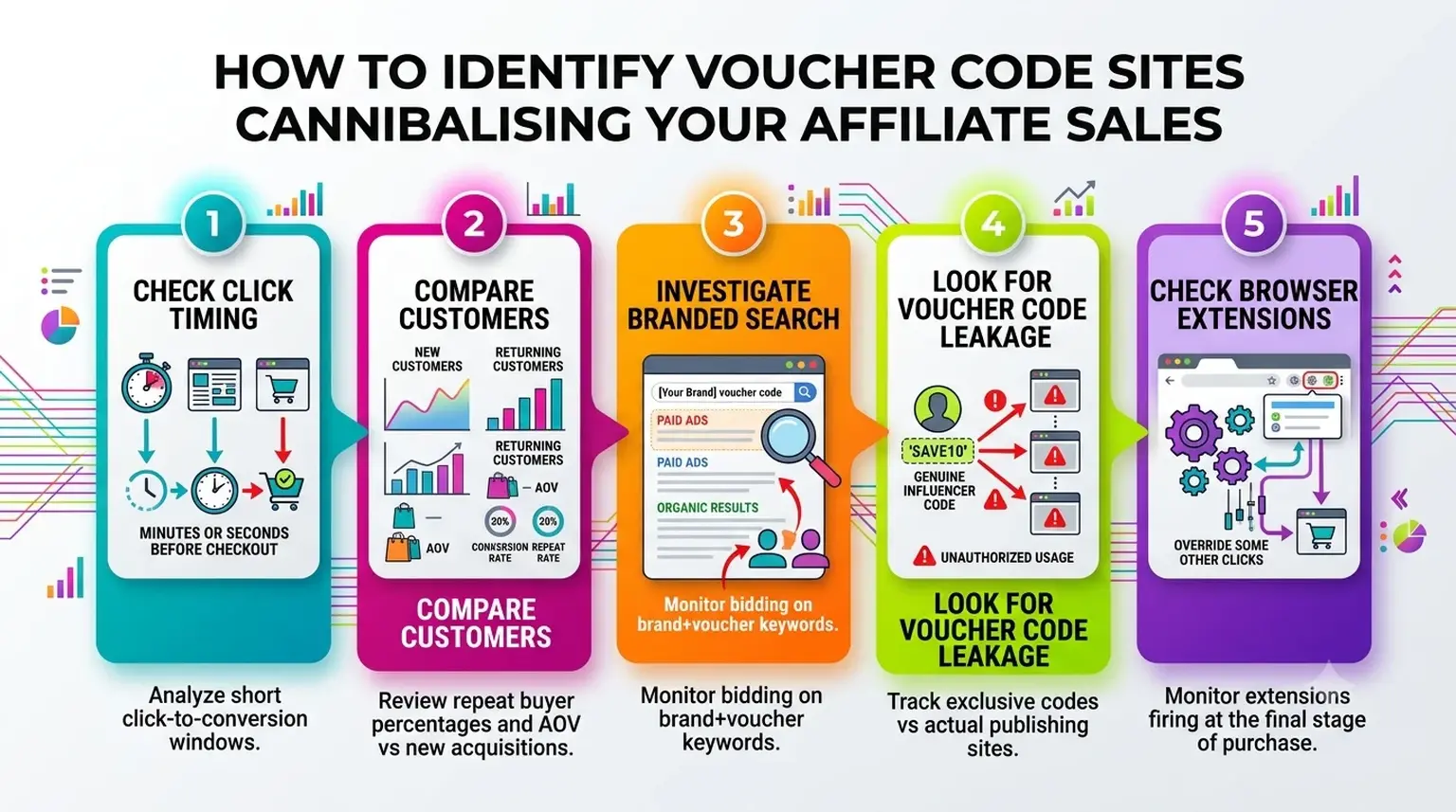
1. Check the timing of affiliate clicks
Start by checking how much time passes between a voucher publisher's click and the completed transaction.
If a publisher regularly receives clicks seconds before checkout, it is worth investigating further.
For example, a customer may have visited your website several times, added products to their basket and then clicked a voucher link immediately before purchasing.
That doesn't automatically mean the publisher is taking credit unfairly. The customer may genuinely have needed an incentive to complete the order. However, if this pattern accounts for most of the publisher's conversions, you need to understand what value it adds.
Compare click-to-conversion times across voucher publishers, content websites, cashback partners and influencers.
2. Compare new and returning customers
A voucher publisher generating 1,000 transactions might look more valuable than a content publisher generating 300. But what happens when you compare customer acquisition?
Review:
New and returning customer percentages.
Average order value.
Revenue from first-time purchases.
Repeat purchase rates.
Commission paid against net revenue.
A publisher generating mainly repeat customer transactions may be capturing existing demand. However, new customer sales alone don't prove incrementality either. Someone can be a first-time customer and still have arrived through another marketing channel.
Use these metrics together rather than treating any single figure as proof.
3. Investigate branded search activity
Search for your brand name alongside terms such as brand discount code, brand voucher code, brand offers, and brand promo code.
Check which voucher publishers appear and whether they use paid search, organic search or other promotional methods to attract customers.
Pay particular attention to affiliates bidding on branded keywords. If someone searches for your brand with the intention of purchasing, a voucher advert appearing above your own website can redirect that customer through an affiliate tracking link.
Your affiliate programme should clearly state whether brand bidding is permitted.
4. Look for voucher code leakage
Voucher leakage happens when a discount code intended for one publisher appears on other websites without permission.
For example, you might provide an exclusive 10% discount to an influencer. A voucher aggregator then republishes that code without authorisation.
When a customer uses it, the wrong publisher may receive the affiliate commission.
Regularly check your active promotional codes against the websites publishing them. Track where each code was issued, which publisher was authorised to use it and whether the offer is still valid.
5. Check browser extension activity
Browser extensions can create another attribution challenge.
Some extensions automatically search for discount codes when a customer reaches the checkout. If a shopper activates an offer and the extension triggers an affiliate tracking event, the extension provider may receive the final click and commission.
This can happen even when the customer has already decided to purchase.
Look at extension-related publishers separately where your tracking platform allows it. Review click timestamps, redirects, code applications and the interaction that triggered the tracking event.
The tracking platform you use also affects how clearly you can investigate these interactions. When comparing platforms, look beyond basic conversion reporting and check whether they support reliable click tracking, voucher-code attribution and fraud monitoring. Our affiliate tracking tools comparison covers the features worth assessing.
5 ways to stop Voucher Code Sites stealing affiliate sales
Once you have identified publishers that may be taking credit for existing demand, you can start making changes. I would focus on the following five areas.
1. Create separate rules for voucher publishers
Your affiliate programme should have specific terms for voucher and voucher partners. General publisher terms may not cover the different ways these websites operate.
Set out what publishers can and cannot do. This could include:
Whether publishers can bid on your brand name or branded discount terms.
Which discount codes they can promote.
Whether they can advertise exclusive offers.
Whether browser extensions are permitted.
Whether they can use automatic voucher application.
How expired or invalid codes should be handled.
Which transactions qualify for commission.
What happens when a publisher breaches the agreement.
Make sure these rules are communicated before publishers join the programme. Apply them consistently and document any changes.
Clear publisher approval and ongoing management matter just as much as the rules themselves. In our guide to affiliate programme management and growing your affiliate programme, I explain how to review publisher activity, manage commercial terms and keep the affiliate mix aligned with business goals.
2. Use publisher-specific discount codes
Give approved voucher publishers unique codes rather than allowing everyone to promote the same generic offer.
This makes it easier to identify where discount codes are being used and which publishers are responsible for their distribution.
For example, if you issue a 10% code to one approved publisher, you can monitor whether that code appears elsewhere and investigate unexpected usage.
However, unique codes don't solve the entire attribution problem. A customer could still click another affiliate's tracking link before using the code.
You need clear rules explaining whether a code or an affiliate click takes priority when both are present.
3. Adjust commission structures based on publisher value
Not every publisher needs to receive the same commission rate.
A content publisher that introduces new customers may deserve a different rate from a voucher website that mainly converts shoppers who already know your brand.
Start by calculating contribution margin rather than looking at revenue alone.
For example, if an order generates £100 in net revenue and leaves £35 in contribution margin after product costs, fulfilment, payment fees and expected returns, paying £15 in affiliate commission leaves £20.
If that order would probably have happened without the voucher publisher, the £15 commission is an unnecessary acquisition cost.
Consider:
Different commission rates for different publisher types.
Reduced rates for transactions using publicly available discount codes.
Higher incentives for verified incremental new customer sales.
Product-specific commissions where margins vary.
Bonuses for publishers meeting agreed acquisition targets.
The important point is to base commission decisions on commercial value, not simply the number of tracked transactions.
4. Set clear attribution and de-duplication rules
This is where affiliate programme management becomes more technical.
De-duplication ensures that the same transaction isn't counted or paid for multiple times across your marketing channels or tracking systems.
For example, a customer might interact with Google Ads, an influencer link and a voucher publisher before purchasing. Depending on your tracking setup, the sale could appear in multiple platform reports.
Your tracking and reporting processes should ensure that one order isn't treated as three separate sales.
However, de-duplication and attribution are not the same thing. De-duplication prevents double counting, while attribution determines which channel or publisher receives credit.
For voucher cannibalisation, you need both:
De-duplication: Reconcile affiliate transactions against ecommerce order records and other marketing reports. Establish rules for duplicate transaction IDs, refunds, cancellations and overlapping commissions.
Attribution rules: Define when a voucher click can override an earlier affiliate interaction. For example, you could protect an eligible content publisher's commission when a voucher click occurs immediately before checkout without a qualifying new customer incentive.
You should also document how different publisher interactions are treated. An example policy could include:
Exclusive discount codes follow agreed code ownership and usage conditions.
Generic public codes don't automatically override an eligible earlier affiliate interaction.
Qualifying content interactions receive attribution protection under an agreed time window.
Browser-extension conversions are eligible only where the publisher and tracking method have been approved.
Unauthorised brand bidding makes the associated activity ineligible for commission under the programme terms.
Each valid order ID can generate only one eligible affiliate commission.
The exact settings depend on your network, tracking technology and commercial agreements. Don't assume your affiliate platform automatically handles every cross-channel attribution conflict.
5. Monitor publisher activity and enforce the rules
Affiliate management shouldn't stop once a publisher has been approved.
A voucher website that follows your programme rules today might start publishing unauthorised codes or bidding on restricted search terms later.
For brand bidding, regularly search your brand name, misspellings and brand-plus-discount terms. Record any suspicious adverts, including the keyword, advert copy, display URL, landing page and publisher responsible.
Check whether the advert uses an affiliate tracking link and whether the publisher has permission to bid on those terms.
Set up regular checks covering:
New voucher pages and promotional activity.
Brand bidding and paid search placements.
Unauthorised discount code distribution.
Browser-extension tracking activity.
Unusual click-to-conversion patterns.
Changes in new customer contribution.
Commission costs against incremental revenue.
I recommend reviewing high-volume voucher publishers weekly and carrying out a wider publisher audit monthly.
Where a publisher breaches agreed conditions, follow your documented compliance process. Depending on the evidence and severity, action could include a warning, commission reversal where permitted, suspension or removal from the programme.
How to test whether voucher publishers generate incremental sales
The most reliable way to assess voucher publisher value is to test what happens when their activity changes.
Affiliate platform reports can show you which publisher received credit for a transaction. They cannot independently tell you whether that transaction would have happened without the publisher.
I recommend running a controlled incrementality test rather than relying entirely on attributed revenue.
Step 1. Select the publisher you want to test
Start with a high-volume voucher publisher that receives a significant share of your affiliate commission. Avoid testing several publishers at once if you want to understand the effect of an individual partner.
Step 2. Establish a performance baseline
Review at least 8–12 weeks of historical performance where possible. Account for seasonal changes, major promotions, paid advertising activity and other factors that could influence sales.
Record total orders, revenue, new customers, contribution margin, affiliate-attributed revenue and commission costs.
Step 3. Introduce a controlled change
Depending on your agreement and the publisher's activity, temporarily pause a placement, restrict a promotional code or run a suitable audience or geographical holdout test.
Where possible, use a comparable control group that continues to receive the original promotional activity.
Step 4. Compare overall business performance
Look beyond the affiliate platform. Compare total ecommerce orders, revenue, new customer acquisition and contribution margin between the test and control groups.
If affiliate-attributed revenue falls but overall sales remain largely unchanged, this could indicate that the publisher was receiving credit for demand generated elsewhere.
If total sales and contribution margin fall meaningfully, the publisher may have been helping convert customers who needed the offer.
Step 5. Make a commercial decision
Use the results to decide whether to retain the publisher, change its commission rate, restrict certain promotional methods or end the partnership.
Remember that a short-term sales decline doesn't automatically prove incrementality. Seasonality, competitor activity and other marketing changes can influence the result. A well-designed test with an appropriate control is much stronger evidence than a simple before-and-after comparison.
Why removing all Voucher Code Sites isn't the answer
It is tempting to remove voucher publishers altogether, particularly when affiliate commissions are increasing without a corresponding rise in total sales.
But that can create another problem.
Some shoppers genuinely need an incentive to complete their purchase. Others actively search for discounts before deciding which retailer to buy from. An established voucher website can put your offer in front of those customers and help you compete for the sale.
The key is understanding the difference between a publisher that creates additional demand and one that simply captures an existing purchase.
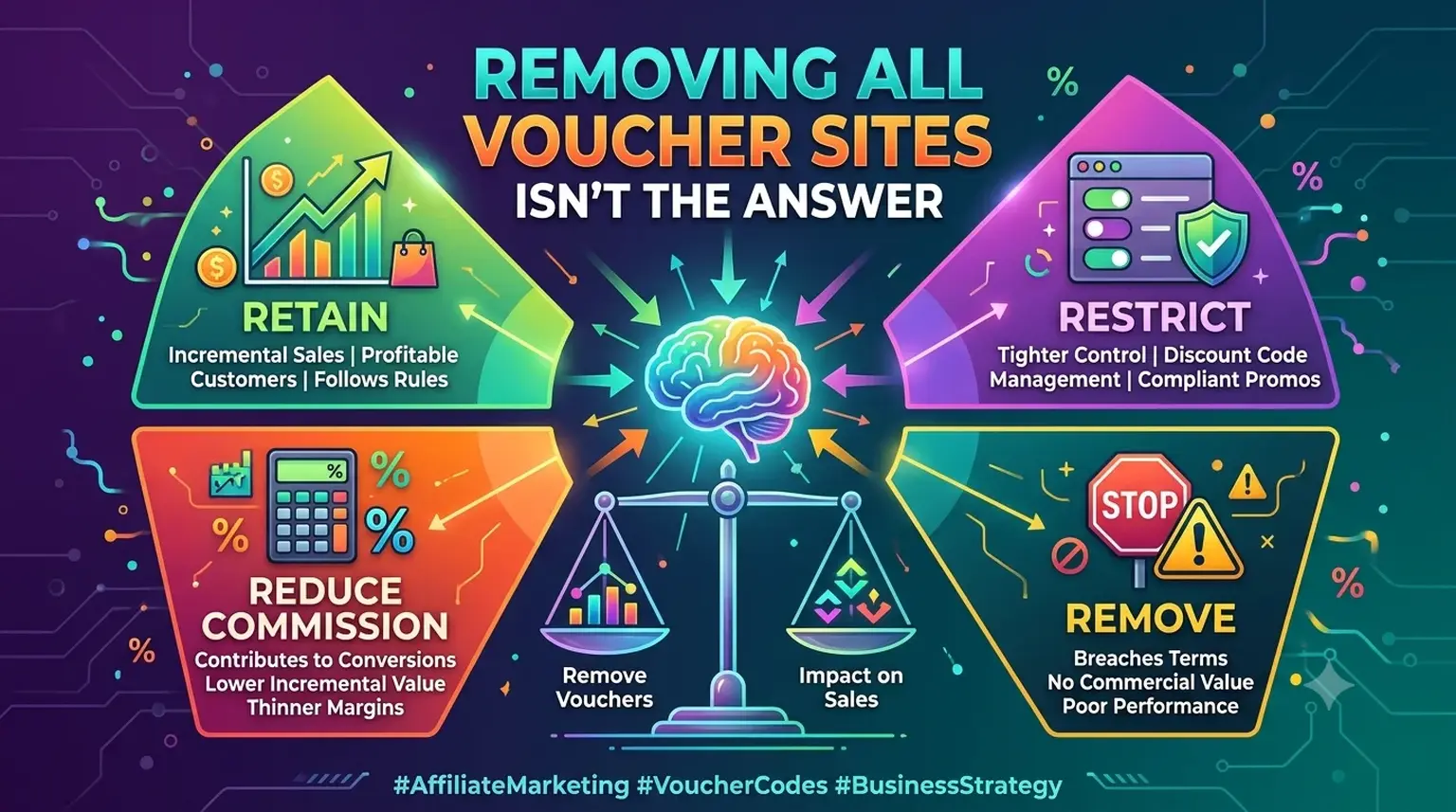
Once you've completed your audit, categorise publishers according to their performance and compliance:
Retain: The publisher generates measurable incremental sales, follows programme rules and delivers profitable customers.
Restrict: The publisher has potential but needs tighter control over discount codes, browser extensions or promotional methods.
Reduce commission: The publisher contributes to conversions but delivers lower incremental value or operates on thinner margins.
Remove: The publisher repeatedly breaches agreed terms or fails to demonstrate sufficient commercial value.
Don't make this decision based on conversion rates alone. Consider incremental revenue, contribution margin, customer acquisition and compliance together.
How CommerceCentric helps prevent affiliate commission cannibalisation
An affiliate programme needs regular management to remain commercially effective. Approving publishers and tracking attributed sales is only part of the job. You also need to understand which partners contribute to additional revenue, whether commission is being allocated correctly and where promotional activity is affecting profitability.
At CommerceCentric, our affiliate management service covers publisher recruitment, programme strategy, commission optimisation, performance reporting and ongoing publisher management.
When reviewing an affiliate programme, we look beyond the revenue reported by individual publishers. We assess the publisher mix, tracking setup, promotional activity, commission costs and opportunities to improve the programme's commercial performance.
Our work with Durex and Finish demonstrates our experience managing affiliate programmes and improving their contribution to ecommerce revenue.
For example, our Durex affiliate marketing case study reports a 521% increase in affiliate revenue and more than 2 million clicks. Our Finish affiliate marketing case study reports a 145% revenue increase, with affiliate marketing accounting for 46% of revenue.
These results demonstrate our affiliate programme management experience, rather than being direct measures of voucher cannibalisation.
If voucher publishers are taking a growing share of your affiliate commission but you're unsure how much additional revenue they generate, a structured affiliate programme audit can help identify where changes are needed.
Get in touch with CommerceCentric to review your affiliate publisher mix, attribution rules and commission efficiency.
Frequently asked questions
How do Voucher Code Sites cannibalise affiliate sales?
Voucher Code Sites can receive affiliate commission when customers click their links immediately before purchasing, even if another publisher or marketing channel originally influenced the decision. This is particularly common with last-click attribution.
How can I stop voucher websites taking credit for existing customers?
Introduce publisher-specific promotional rules, monitor click-to-conversion patterns, review returning customer sales and establish clear attribution conditions. You should also test whether voucher activity generates additional sales before deciding commission rates.
Can browser extensions cause affiliate attribution problems?
Yes. Some browser extensions automatically apply discount codes or trigger affiliate tracking interactions at checkout. If this happens after another publisher has influenced the purchase, the extension may receive last-click commission. Monitor extension activity and define clear approval rules.
What is the difference between affiliate cannibalisation and affiliate fraud?
Affiliate cannibalisation happens when a publisher receives commission for a sale that may have happened without its involvement. Affiliate fraud involves deceptive or prohibited activity intended to generate commissions improperly. Cannibalisation is not automatically fraud, although certain methods of obtaining attribution can breach programme terms.
How do I measure whether a voucher publisher generates incremental revenue?
Use controlled tests where possible. Compare total orders, revenue, new customers and contribution margin between exposed and control groups. Affiliate-attributed revenue alone cannot establish whether the publisher created additional sales.
Should voucher publishers receive lower affiliate commission?
Not automatically. Commission should reflect the publisher's contribution, customer acquisition value and profitability. A voucher publisher generating incremental new customers may justify a higher rate than one primarily converting existing demand.

Mark Kelly - Client Marketing Director
Paid media and growth marketing specialist with 20+ years of experience driving customer acquisition and eCommerce performance.