Affiliate Marketing Trends 2026: 8 Changes for Ecommerce Brands
17/11/2026 Written by Philip Driver
Affiliate marketing has changed considerably over the past year. But the biggest shift isn't simply that more businesses are investing in the channel. It's the way that investment is being distributed across different types of partners.
Traditional affiliates such as cashback websites, voucher platforms and content publishers still play an important role. However, ecommerce brands are increasingly working with Comparison Shopping Services (CSS), influencers, closed-user groups, deal communities and technology partners to reach customers and generate sales.
Consumer behaviour is changing too. With shoppers paying closer attention to prices, promotions and product value, more customers are comparing products, checking available offers and looking for additional rewards before making a purchase.
The latest industry figures reflect this growth. According to the Affiliate and Partner Marketing Association's (APMA) State of the Affiliate Nation 2026 report, UK brands invested £1.8 billion in affiliate and partner marketing during 2025, generating £20.7 billion in revenue across 357 million tracked transactions.
What's particularly interesting is where this investment is going. CSS and technology partners recorded 18% year-on-year growth, while influencer and social partnerships grew by 15%. In comparison, spending through discount, deals and voucher partners declined by 7%.
This tells us something important about the direction of the industry. Affiliate marketing is expanding beyond its traditional reliance on cashback, voucher and content publishers. Retailers are putting more attention into comparison-based, content-led and technology-driven partnerships.
For ecommerce brands, the question is no longer just how to recruit more affiliates. It's which partnerships are worth investing in, how they contribute to customer acquisition and whether they generate sales that wouldn't otherwise happen.
In this article, we'll look at eight changes shaping affiliate marketing in 2026 and what ecommerce businesses should do differently.
What you'll learn:
Which affiliate partner types are growing in 2026.
Why CSS, influencers and closed-user groups are gaining attention.
How programmatic affiliate marketing and card-linked offers work.
How retailers can improve customer acquisition through affiliate partnerships.
Which metrics matter beyond last-click revenue.
How to improve an existing affiliate programme over the next 90 days.
1. Affiliate marketing is becoming a much bigger sales channel
One of the biggest changes we've seen is the variety of partners now contributing to affiliate sales.
Traditional affiliates such as cashback websites, voucher platforms and product review publishers remain important. However, brands are increasingly working with comparison shopping services, influencers, loyalty platforms, closed-user groups and specialist technology partners.
This gives retailers more opportunities to reach customers at different stages of their buying journey.
For example:
Cashback websites: Encourage customers to complete a purchase by offering a financial reward.
Product comparison websites: Help shoppers compare prices and find suitable products.
Influencers: Introduce products through recommendations, demonstrations and user-generated content.
Deal communities: Bring customers to retailers through exclusive offers and discounted products.
Closed-user groups: Connect brands with specific membership-based audiences.
Technology partners: Use different advertising and targeting methods to support customer acquisition.
Consumer behaviour is also playing a part. With shoppers paying more attention to the value of their purchases, comparison websites, cashback platforms and deal communities are becoming important touchpoints in the buying journey.
The APMA's 2026 research found that the UK affiliate and partner marketing industry grew by 7.3% in 2025, while tracked revenue increased by 8%.
However, growth isn't happening equally across all partner types. Retailers are becoming more selective about where they invest and which partnerships deliver the best commercial returns.
The important point is not to recruit as many affiliates as possible. It's to build a partner mix that reaches the right customers and generates additional sales without unnecessarily increasing acquisition costs.
2. Comparison Shopping Services (CSS) are becoming a bigger part of ecommerce acquisition
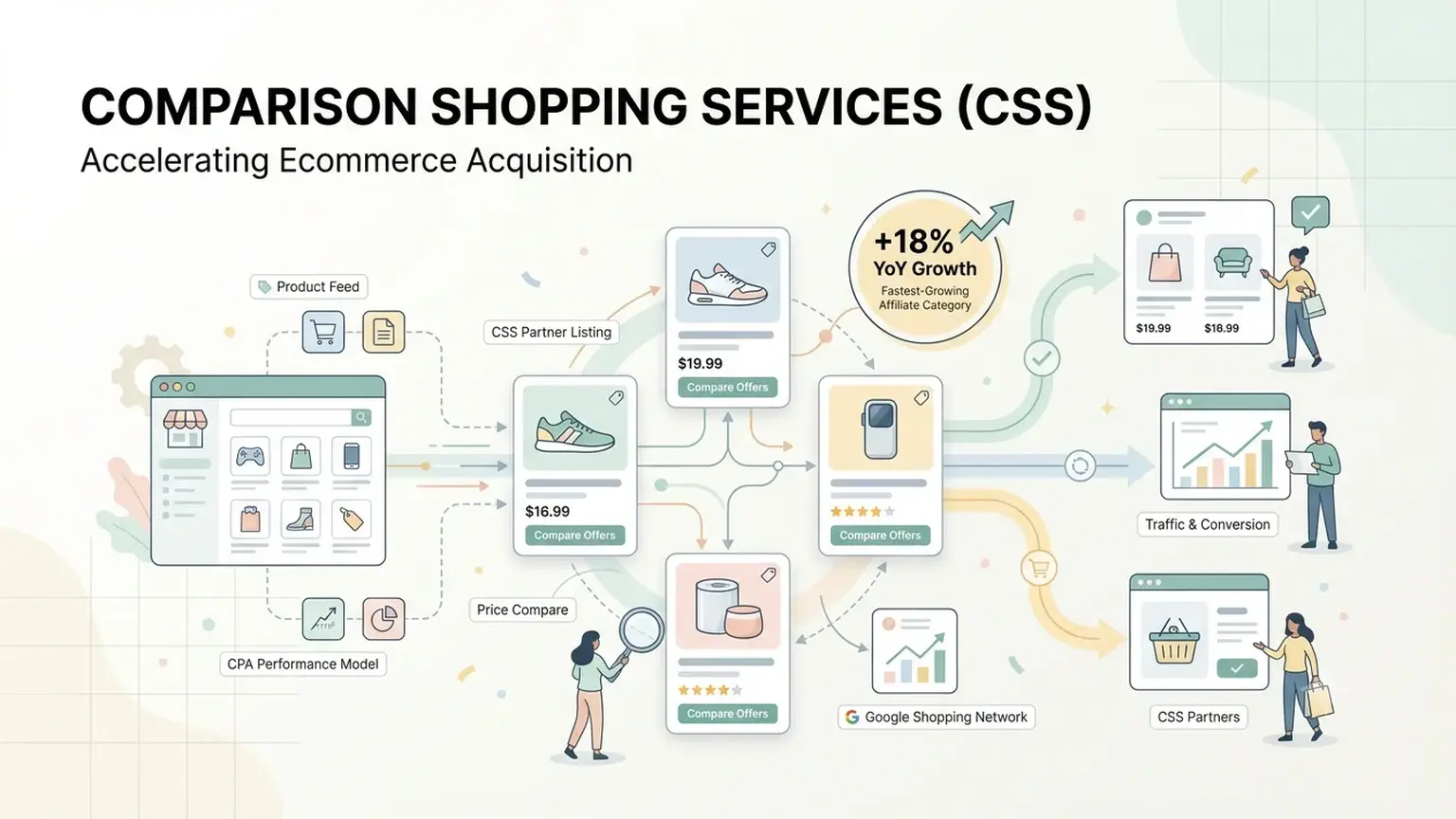
One of the clearest changes in affiliate marketing is the growth of Comparison Shopping Services (CSS).
A CSS partner helps retailers promote their product listings through Google Shopping. Instead of managing every aspect of product advertising themselves, retailers can work with CSS providers that manage campaigns through agreed commercial arrangements.
For retailers, this offers another way to generate product visibility and sales without relying entirely on their existing Google Shopping activity.
The APMA's 2026 report recorded 18% year-on-year growth in CSS investment, making it one of the fastest-growing affiliate partner categories.
We are seeing why this model appeals to ecommerce businesses. Retailers are looking for ways to supplement their existing Google advertising budgets while maintaining control over acquisition costs.
CSS partnerships can operate through performance-based CPA arrangements, where the retailer pays an agreed amount for qualifying sales. This can make them an attractive addition to an existing acquisition strategy.
However, CSS isn't simply a cheaper replacement for Google Shopping. Its performance depends on product margins, feed quality, campaign structure and how it interacts with existing advertising activity.
Before working with a CSS partner, we recommend checking:
Product feed quality: Are product titles, images, prices, availability and GTINs accurate?
Product margins: Can the business afford the agreed CPA or commission after product and fulfilment costs?
Campaign overlap: Are CSS campaigns competing with existing Google Shopping activity?
Conversion tracking: Are transactions recorded correctly across existing channels?
Incrementality: Is the partner generating additional sales or simply taking credit for existing demand?
It's also important to distinguish Google CSS from Microsoft Shopping activity. CSS is a specific Google Shopping partner model. Microsoft/Bing Shopping campaigns operate separately, although some providers offer services across both platforms.
CSS readiness checklist
| What to check | Why it matters |
|---|---|
| Product feed accuracy | Prevents poor product information from affecting campaign performance. |
| Stock and pricing updates | Avoids advertising unavailable products or incorrect prices. |
| Commission and CPA | Ensures the campaign remains commercially viable. |
| Existing Shopping campaigns | Helps identify potential overlap and competition. |
| Tracking and attribution | Reduces duplicate commission payments. |
| Incremental performance | Shows whether the partnership adds value. |
CSS is particularly worth considering for retailers with broad product catalogues, competitive pricing and sufficient product margins. For businesses with poor feeds or limited margins, fixing the fundamentals should come first.
3. Influencers are becoming performance-based affiliate partners
Influencer marketing and affiliate marketing are increasingly working together.
Traditionally, brands often paid influencers a fixed fee to create content or promote products. While this approach still has a place, more creators are now using affiliate links and discount codes to earn commission from the sales they generate.
This changes the commercial relationship. Rather than measuring a creator campaign only through reach, views and engagement, brands can also assess clicks, conversions and revenue.
There are several ways to structure these partnerships:
Commission only: The creator earns an agreed percentage of qualifying sales.
Fixed fee plus commission: The creator receives payment for producing content as well as commission on sales.
Product gifting plus commission: The brand supplies products and rewards the creator for sales generated.
Hybrid arrangements: Brands agree a fixed placement or content fee alongside performance-based commission.
The right structure depends on the creator, the product and the campaign objectives.
Awin's 2026 Power 100 research found that blogger and influencer representation within its index increased by 180% compared with its previous index in 2024. This reflects how much more prominent creators have become within affiliate partnerships, although it should not be interpreted as 180% growth across the entire influencer market.
We've seen the practical value of this approach through our work with Air Wick.
We helped launch its affiliate programme, recruit hundreds of affiliates and work with established promotional partners. We also activated an influencer affiliate who generated more than 56 pieces of content.
The published case study reports a 100% increase in revenue and affiliate revenue accounting for 60%.
For brands considering this model, we recommend agreeing the following before launching:
Commission rates and payment terms.
Unique tracking links and discount codes.
Content production and usage rights.
Whether content can be reused in paid social campaigns.
Creator-level sales and conversion reporting.
Clear advertising disclosures.
The last point is particularly important. Under UK ASA/CAP guidance, affiliate content needs to be clearly identifiable as advertising. A commission-based affiliate link or discount code should not be hidden behind vague labels such as "collab".
Both brands and creators have responsibilities when it comes to advertising disclosures. The ASA Influencers' Guide provides useful guidance on this.
4. Closed-user groups are giving brands access to more targeted audiences
Another noticeable change is the growing importance of closed-user groups (CUGs).
These are membership-based platforms that give eligible customers access to exclusive discounts, rewards and promotions. Unlike public voucher websites, access is usually restricted to a particular group.
Examples include:
Blue Light Card for eligible emergency service workers and other qualifying groups.
Student discount platforms.
Employee benefit and workplace discount schemes.
Membership-based rewards communities.
Platforms offering discounts to specific professional groups.
For retailers, these partnerships provide an opportunity to promote products to audiences with a shared characteristic or membership.
For example, a retailer selling fitness equipment might want to reach student audiences, while a home and lifestyle brand could benefit from promoting relevant offers through employee discount platforms.
Closed-user groups also provide a different promotional environment. Customers are accessing offers through a membership they already use, rather than necessarily searching for a discount code on a public website.
Awin's 2026 research highlights how quickly this area is changing. Looking at its top 10 global coupon and closed-user group partners, the share of sales attributed to closed-user groups increased from 34% to 52%, overtaking coupon partners.
This is an important development for retailers looking to diversify their affiliate partnerships.
However, brands should assess the quality of each audience, the cost of the offer and whether the partnership is generating genuinely additional purchases. A high volume of discounted sales does not automatically mean better profitability.
5. Deal communities and social media groups are driving promotional sales
Deal websites have been part of affiliate marketing for years, but their role in ecommerce promotions remains significant.
Platforms such as HotUKDeals and Latest Deals give retailers access to shoppers who actively look for discounts, special offers and reduced-price products.
What's changed is the growing importance of deal-sharing communities and social media groups alongside traditional deal websites.
Facebook deal groups, for example, allow members to share promotions, clearance products and limited-time offers with communities of bargain-focused shoppers.
This can create a sudden increase in traffic and sales when a retailer has a particularly attractive offer.
For brands with seasonal stock, discontinued products or excess inventory, these partnerships can be especially useful.
Rather than relying solely on paid advertising to promote clearance products, retailers can use deal affiliates to put offers in front of people who are actively looking for savings.
However, there is an important industry development worth considering.
The APMA's 2026 research recorded a 7% decline in investment through discount, deals and voucher partners during 2025. This was the second consecutive year of decline in real terms.
That doesn't mean deal communities are no longer useful. It suggests retailers are becoming more selective about their promotional spending and are looking more closely at the value individual partners generate.
Before sharing a deal, retailers should consider:
Stock availability: Can the business fulfil an increase in orders?
Profit margins: Does the discounted price still leave enough margin after commission?
Promotion duration: Is the offer available for a limited period?
Product selection: Is the deal suitable for clearance stock or products with sufficient inventory?
New customers: Is the campaign attracting new buyers or mainly rewarding existing customers who would have purchased anyway?
We've worked with established deal and promotional partners across several affiliate programmes.
For example, our work with Durex included promotions through websites such as HotUKDeals, Latest Deals, 10 Ways and Extreme Bargains.
The programme generated more than 3.5 million website sessions, recruited over 2,000 affiliates and grew to account for more than 20% of total sales.
This demonstrates how promotional affiliates can contribute to a wider ecommerce growth strategy when they are managed properly.
Read our Durex affiliate marketing case study to see how we approached the programme.
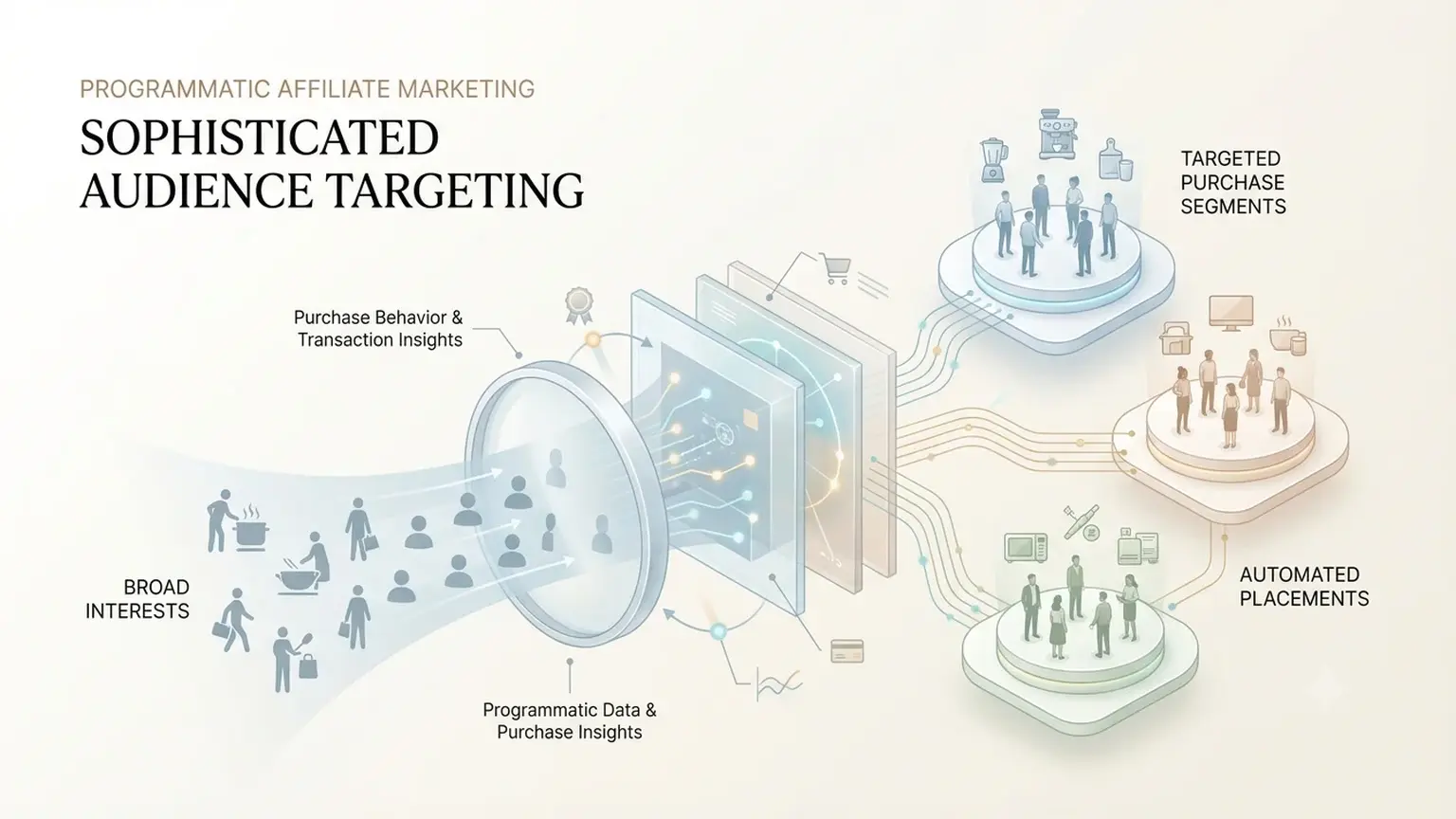
6. Programmatic affiliate marketing is making audience targeting more sophisticated
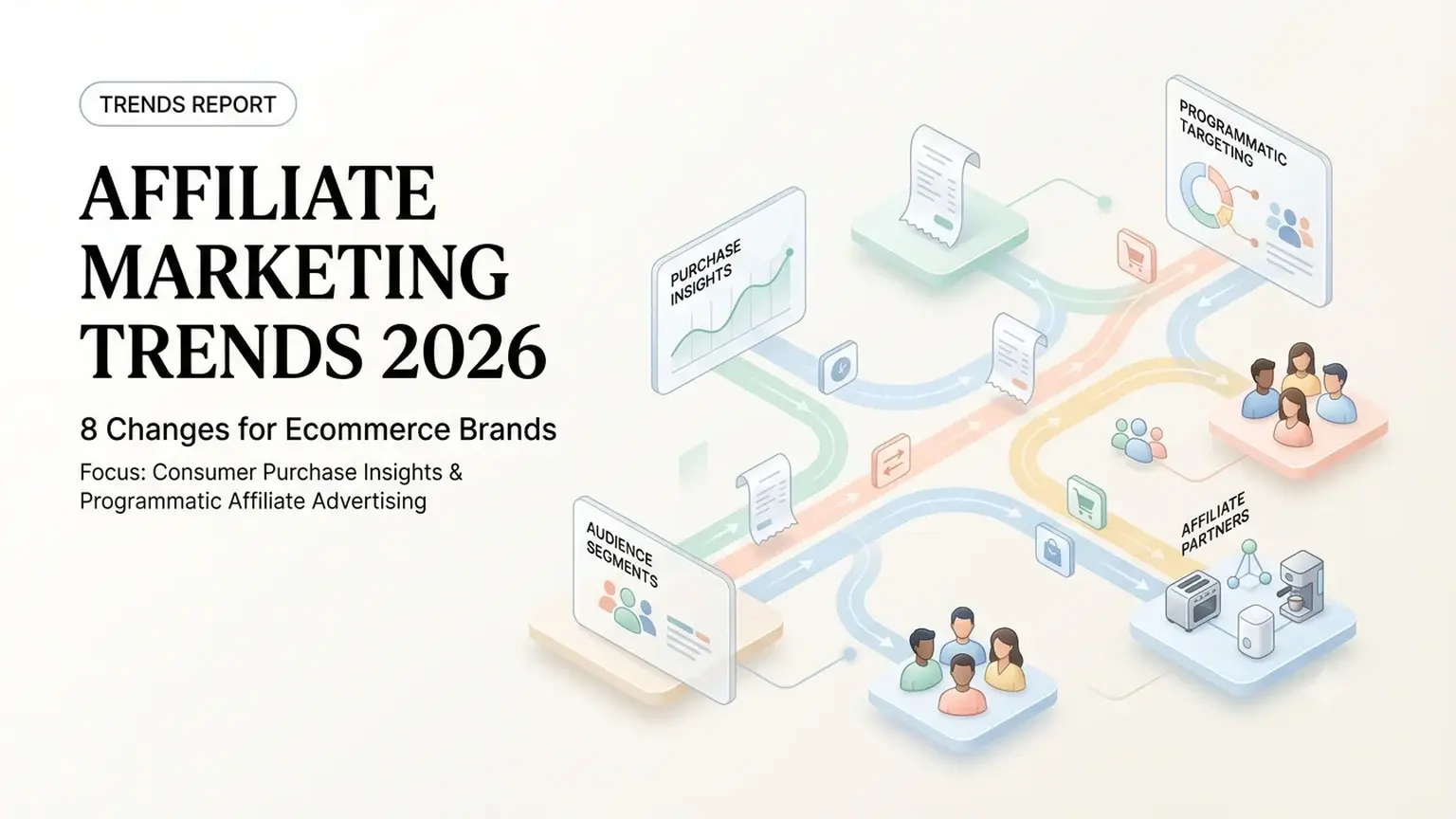
Another development worth paying attention to is the use of consumer purchase insights to inform affiliate advertising.
Programmatic affiliate marketing isn't one single model. It can involve technology partners using approved data sources, audience segmentation and automated advertising placements to reach relevant consumers.
One example is the use of aggregated Mastercard transaction insights to identify audience segments based on purchasing behaviour.
Consider an ecommerce business selling premium kitchen appliances.
Rather than targeting everyone interested in cooking, a partner could use approved and aggregated purchasing insights to identify audience groups showing relevant spending patterns. The brand could then reach those groups through agreed advertising placements.
The aim is to make campaigns more relevant by using purchasing behaviour as an additional targeting signal.
This can offer opportunities to:
Reach audiences based on relevant purchasing patterns.
Improve the relevance of product advertising.
Support customer acquisition beyond traditional affiliate websites.
Test new audience segments.
Assess performance against agreed acquisition targets.
However, brands need to understand the mechanics behind these campaigns. They should establish where the data comes from, how audiences are created, which advertising channels are used, what permissions and lawful basis apply, and how conversions are attributed.
Transaction insights should not be confused with unrestricted access to individual cardholders' purchase histories.
It's also important to distinguish this model from card-linked offers. Programmatic campaigns use data to inform audience targeting and advertising delivery. Card-linked offers use eligible payment transactions to trigger customer rewards. They can both involve financial data partners, but they serve different purposes.
For ecommerce brands, the opportunity is to assess whether these partnerships can add value beyond existing acquisition channels, rather than adopting them simply because they use new technology.
7. Card-linked offers are changing how affiliate rewards work
Card-linked offers (CLOs) give retailers another way to reward customers without relying on a traditional affiliate tracking link at the point of purchase.
The model connects a promotional offer to an eligible payment card. Customers register their card with a participating rewards platform and receive cashback or another reward when they complete a qualifying transaction with a retailer.
For example:
A customer registers an eligible payment card with a rewards platform.
They see an offer from a participating retailer.
They make a qualifying purchase using their registered card.
The transaction is matched against the offer.
The customer receives the agreed cashback or reward.
The important difference is that the customer doesn't need to click an affiliate link immediately before purchasing. The transaction is matched through the payment card and the platform's tracking arrangements.
For retailers, this creates another opportunity to connect with customers through banking, payment and loyalty partnerships.
Card-linked offers can be particularly useful for brands looking to:
Encourage repeat purchases.
Increase customer engagement.
Promote specific products or categories.
Reach customers through banking and rewards platforms.
Run targeted promotions without relying entirely on traditional affiliate links.
However, card-linked offers should be assessed on their commercial performance, not just the number of transactions they generate.
Brands should understand:
The reward or cashback cost.
Eligible products and transaction conditions.
How transactions are matched and validated.
Cancellation and refund handling.
Whether the offer attracts additional customers.
How performance is reported and attributed.
As with other affiliate partnerships, the key question is whether the reward is generating additional sales or simply paying customers for purchases they would have made anyway.
8. Affiliate measurement is moving beyond last-click sales
As affiliate marketing expands into new partnership models, measuring performance becomes more complicated.
Traditional affiliate reporting has often focused on the last click before a purchase. This approach works for many conversion-focused partners, but it doesn't always reflect the contribution of every affiliate involved in the customer journey.
Consider a customer purchasing a new product.
They might first see it in an influencer's video, read a product review, compare prices through a CSS partner and finally complete the purchase after seeing a cashback offer.
If the brand only looks at the final tracked interaction, the earlier partners may receive little or no recognition for their contribution.
This is one reason why affiliate marketing is moving towards a broader view of performance.
The APMA's 2026 research found that close to £1 in every £5 of affiliate investment now sits outside traditional last-click CPA arrangements, including tenancy, hybrid and other commercial models.
For brands, this means evaluating affiliate partners using more than just the number of sales they generate.
Here are the metrics we recommend monitoring:
| Metric | How to calculate or assess it | Why it matters |
|---|---|---|
| Affiliate revenue | Total tracked sales value | Shows the revenue attributed to the programme. |
| Net revenue | Sales revenue minus cancellations and returns, excluding VAT where applicable | Gives a more realistic view of retained sales. |
| CPA | Affiliate costs divided by acquired customers or qualifying sales | Measures acquisition efficiency. |
| New-customer rate | New affiliate customers divided by total affiliate customers × 100 | Shows how well affiliates attract new buyers. |
| Contribution margin | Net revenue minus product costs, discounts, commission and relevant variable costs | Shows whether sales are commercially profitable. |
| Incremental revenue | Additional revenue generated compared with an appropriate baseline or control | Helps identify the genuine value of affiliate activity. |
| Incremental ROAS | Incremental revenue divided by incremental marketing costs | Measures return from additional activity. |
| Refund rate | Refunded or cancelled orders divided by total orders × 100 | Helps identify low-quality sales. |
We would also recommend monitoring partner concentration. If a large percentage of affiliate revenue comes from only a handful of publishers, the programme could be exposed if one partner changes its commercial terms or stops promoting the brand.
We've seen why this matters when managing established affiliate programmes.
For example, our work with Finish helped the brand generate more than 2 million clicks, a 145% revenue increase and affiliate revenue accounting for 46% of total revenue.
Achieving this required more than simply increasing the number of affiliates. We worked across network selection, programme setup, affiliate recruitment, promotional planning and ROAS optimisation.
Read our Finish affiliate marketing case study.
The lesson is that affiliate performance needs to be assessed against the commercial value it creates, not just the number of tracked transactions.
Affiliate marketing risks ecommerce brands need to manage
Having access to more affiliate partners creates more opportunities, but it also makes programme management more important.
A larger affiliate programme doesn't automatically mean a more profitable one. Brands need to understand where their sales are coming from, how commissions are being awarded and whether partners are genuinely contributing additional revenue.
There are several risks worth monitoring.
Coupon-code leakage
Customers may find a voucher code through an affiliate website immediately before completing a purchase, even if they already intended to buy. This can result in commission being paid without the partner generating additional demand.
Last-click attribution
A partner can receive credit for a sale because they were the last tracked interaction, even if an influencer, content publisher or another marketing channel introduced the customer to the product.
CSS campaign overlap
Retailers should understand how CSS activity interacts with their existing Shopping campaigns to avoid unnecessary competition and duplicated acquisition costs.
Affiliate fraud and poor-quality traffic
Unauthorised paid search, cookie stuffing, misleading promotional activity and suspicious conversion patterns can affect programme profitability. Brands should regularly review traffic sources, transactions and partner activity.
Data protection and privacy
Campaigns using transaction insights or customer data need appropriate data governance. Brands should understand the data source, permissions, lawful basis, audience creation and responsibilities of their partners.
Influencer advertising disclosures
Creators using commission-based links or codes need to make their advertising relationships clear. Brands should include disclosure requirements in their affiliate agreements and monitor compliance.
Margin erosion
High commissions, excessive discounting and blanket promotional rates can reduce profitability. Commission structures should reflect product margins and the actual value each partner contributes.
A successful affiliate programme is not measured by how many partners it has or how much revenue appears in a tracking platform. It's measured by the additional value those partners create for the business.
How to improve your affiliate marketing strategy: A practical 90-day plan
If you're reviewing your affiliate programme in 2026, we recommend taking a structured approach rather than introducing several new partner types at once.
Here's how we would approach the first 90 days.
| Timeframe | What to do | What to measure |
|---|---|---|
| Days 1–30: Audit | Review existing affiliates, commissions, tracking, traffic quality, promotional activity and attribution. Identify partners that aren't adding sufficient value. | Revenue, CPA, commission costs, refunds and partner contribution. |
| Days 31–60: Test | Introduce two or three relevant partnership opportunities, such as CSS, influencer affiliates or closed-user groups. Agree commercial terms and measurement before launching. | New customers, incremental revenue, conversion rate and acquisition costs. |
| Days 61–90: Optimise | Review the results, adjust commission structures, improve placements and increase investment in partners delivering profitable additional sales. | Incremental ROAS, contribution margin, new-customer rate and partner concentration. |
The important thing is to establish a baseline before introducing new partnerships. Otherwise, it's difficult to know whether the new activity is improving performance or simply shifting sales between channels.
If you already have an established programme, an affiliate programme audit can help identify underperforming partners, attribution issues and opportunities to improve commercial returns.
Final thoughts: Affiliate marketing is changing, but profitability still matters
Affiliate marketing is no longer limited to traditional cashback, voucher and content publishers. CSS, influencers, closed-user groups, programmatic partnerships and card-linked offers are giving ecommerce brands more ways to reach customers and generate sales.
However, the latest industry figures also show that growth is not happening equally across every partner type. Retailers are becoming more selective about where they invest, how they reward affiliates and which partnerships contribute additional value.
For ecommerce businesses, the next step isn't simply to recruit more partners. It's to understand which models suit their customers, protect product margins and build a programme that delivers profitable growth.
At CommerceCentric, we manage affiliate programmes with a focus on partner selection, commercial performance, promotional planning and ongoing optimisation.
From affiliate recruitment and network selection to commission management, reporting and programme audits, our team works with ecommerce brands to make affiliate marketing deliver measurable business growth.
If you want to understand whether your existing programme is working as hard as it should, speak to our team about our affiliate marketing management services and free programme audit.
Frequently asked questions
What are the biggest affiliate marketing trends in 2026?
The biggest affiliate marketing trends in 2026 include the growth of CSS, influencer affiliate partnerships, closed-user groups, technology-led targeting and card-linked offers. There is also a greater focus on measuring incremental sales and using different commercial models rather than relying entirely on last-click CPA.
Are Comparison Shopping Services part of affiliate marketing?
Yes. CSS providers can operate as affiliate partners, promoting retailers' products through Google Shopping using agreed commercial arrangements. They offer another way to generate product visibility and sales, often through performance-based payment models.
What is the difference between affiliate marketing and influencer marketing?
Affiliate marketing rewards partners for generating qualifying clicks, leads or sales. Influencer marketing usually involves creators promoting products to their audiences, often through fixed-fee campaigns. The two overlap when influencers use tracked affiliate links or discount codes and earn commission from the sales they generate.
How do you measure incremental affiliate revenue?
Incremental affiliate revenue is the additional revenue generated because of affiliate activity, rather than sales that would have happened anyway. Brands can assess this through suitable control groups, holdout tests, historical comparisons and partner-level analysis, taking other marketing activity and seasonal changes into account.
How do card-linked offers work for ecommerce businesses?
Card-linked offers connect promotions to customers' registered payment cards. When a customer completes an eligible purchase using their registered card, the transaction is matched and a cashback payment or reward is issued. The customer does not need to click a traditional affiliate link at the point of purchase.
Which affiliate partners should ecommerce brands prioritise?
The right partners depend on the brand's products, margins, customers and objectives. CSS providers may suit retailers with large product catalogues, influencers can support product awareness and recommendations, while closed-user groups and cashback platforms can help reach customers looking for relevant rewards. Partner selection should be based on commercial value rather than publisher volume.
How can ecommerce brands avoid affiliate commission leakage?
Brands should regularly review voucher-code usage, partner activity, attribution rules and transaction quality. They should also monitor whether publishers are introducing customers or receiving commission for sales that would have happened without their involvement.
When should a business use an affiliate marketing agency?
An affiliate marketing agency can help when a business needs to launch a new programme, recruit relevant partners, improve an existing programme or address poor performance. An experienced agency can also support network selection, commercial negotiations, commission structures, promotional planning, tracking and ongoing optimisation.

Philip Driver - Strategy Director
Digital marketing leader with 20+ years of experience helping global brands grow through data-driven marketing strategies.